How Nutrition Panels Became a Familiar Feature of Food Packaging
The history of the nutrition panel traces how rules shaped a familiar food-pack format, helping readers spot its origins and what changed over time.
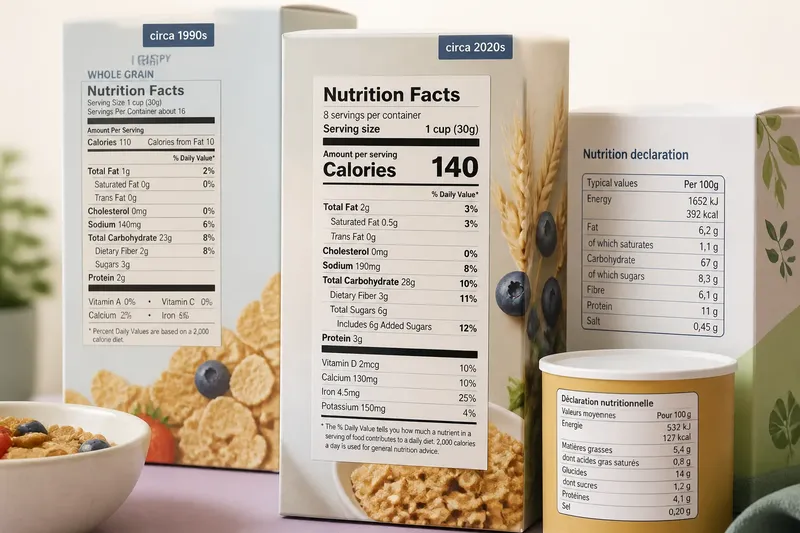
The common mistake is to treat today’s nutrition panel as an old, universal fixture; that misses how recently many familiar label rules took shape and how much they still differ between countries. The history of the nutrition panel is a story of governments gradually turning selected food information into a recognisable part of the pack.
There is no single worldwide timeline. Rules were introduced in different places at different times, and some early requirements applied only in particular circumstances. A useful short history therefore needs dates and jurisdictions, not a claim that every packet followed the same path.
Early rules focused on claims and specific disclosures
In the United States, the Nutrition Labeling and Education Act of 1990 amended federal food law to require nutrition labelling on most packaged foods, with exceptions, and to regulate nutrition claims. The Food and Drug Administration’s implementing rules followed in the early 1990s; the familiar Nutrition Facts format appeared on food packages from the mid-1990s.
That was a major shift from a system in which nutrition information was not routinely presented in one standard panel on most packaged foods. Before the change, federal rules already addressed certain nutrition claims and disclosures, but a claim could prompt information that shoppers would not necessarily find on a comparable product without a claim.
The American panel was not simply a longer ingredient list. It grouped energy and selected nutrients in a prescribed layout, giving shoppers a consistent place to look. The format also reflected policy choices about which details mattered for public information and how they should be presented.
The United States revised the panel as its rules changed
The FDA announced major updates to the Nutrition Facts label in 2016. The revised design gave calories and serving information greater visual prominence, updated the nutrients required to be listed, and changed the way certain values were declared. The FDA set compliance deadlines that varied by manufacturer size, so the new design reached shelves over time rather than appearing everywhere at once.
Those revisions show why a panel’s history is not a straight march towards ever more information. Regulators can change the selected nutrients, presentation and reference information as their rules evolve. A new design may make a particular detail easier to notice, while still leaving other questions outside the panel’s scope.
For a concrete way to read that change, imagine you have an older cereal box and a newer one from the United States. You notice that the newer panel gives calories and serving details more prominence, then check the dates and nutrient lines rather than assuming every number is directly comparable across editions. The result is a more careful reading: the design changed under updated rules, so the panel’s date and stated basis matter.
European rules took a different route to mandatory information
In the European Union, Regulation (EU) No 1169/2011 on food information to consumers established a broad framework for food labels and made nutrition declarations mandatory for most prepacked foods, subject to listed exceptions. Its nutrition declaration requirements generally applied from 13 December 2016. The regulation specifies a core set of information and presentation rules, but it is not the same system as the United States Nutrition Facts label.
The comparison matters because “standardised” does not mean “identical everywhere”. The EU framework uses its own terminology, units and required presentation. Other countries have developed their own rules and formats too. A traveller or shopper looking at an imported packet may recognise the general idea of a nutrition table while meeting different conventions.
These milestones also reveal two different kinds of history: when a jurisdiction required information, and how a particular layout was revised. Neither date tells the whole story of every label, because exemptions, product categories and implementation schedules can affect what appears on a pack.
Why did nutrition panels change over time?
What changed on the United States Nutrition Facts label?
The FDA’s 2016 revision altered the visual emphasis and updated parts of the required nutrient information, following the original standard panel introduced in the 1990s. The precise effect on a particular package depends on its product category and the applicable rules.
When did nutrition declarations become mandatory in the European Union?
Regulation (EU) No 1169/2011 set the framework, with the main nutrition declaration requirements generally applying from 13 December 2016. The regulation includes exceptions, so not every food package must display the same declaration.
Do nutrition panels follow one global format?
No: national and regional authorities set their own requirements for terms, units, nutrients and layout. A familiar table can therefore contain local conventions that differ from those on another country’s packaging.
Why do some older packets have no nutrition panel?
Rules and implementation dates have changed, and exemptions can apply to particular products or circumstances. A missing panel alone does not show why the package was labelled that way; the relevant jurisdiction and product rules matter.
A familiar grid still reflects policy choices
Standardisation made certain details easier to locate, but it did not turn the panel into a complete account of a food. The table reports selected information in a prescribed form; it does not describe every ingredient, production choice, flavour or role the food might have in a meal.
Its visual design carries meaning too. Prominent figures, headings and grouping direct attention, while the details selected for inclusion reflect the rules in force. Front-of-pack symbols may offer a quicker summary, but their scope depends on the system that created them.
When you encounter a panel, first notice where it comes from and which version of the rules it appears to follow. That small piece of context helps explain why the format looks familiar, why its details may differ from another country’s label, and what the table was designed to tell you.