Why Ingredient Lists Run in Descending Order
Why ingredient lists run in descending order: learn what the sequence tells you about a food, where it can mislead, and what to check next.
The most common mistake with ingredient lists is treating the first item as a verdict on the whole food. That can make a familiar ingredient sound alarming or a short list seem automatically virtuous. Why ingredient lists run in descending order is useful to know, but the sequence answers a narrower question: which ingredients contribute more by weight, from greatest to least, when the food is made.
Start by finding the ingredient list for the product as sold
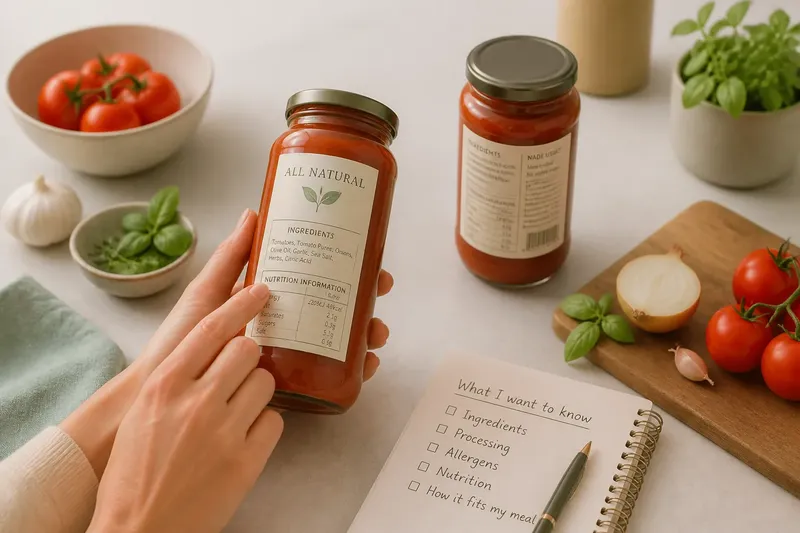
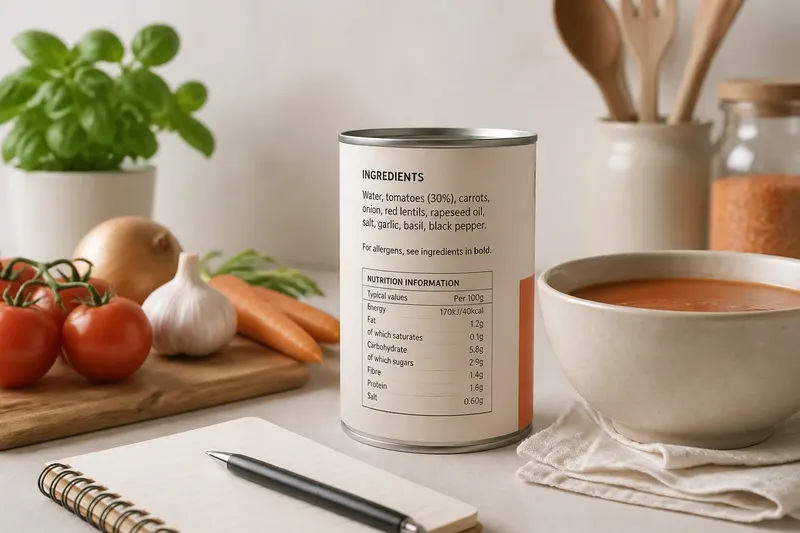
Look for a heading such as “Ingredients” or “Ingredients:”. On a packaged loaf, soup or jar of sauce, the list is usually printed beside or near the nutrition information, though its position varies. Read the list for the product in your hand rather than relying on a shop description, a front-of-pack phrase or an online image that may show an older version.
The ordering convention gives the list its basic shape: ingredients are generally named in descending order of weight at the point they are used in the product. The first entry contributes more weight than the next, the next more than the one after it, and so on. This is an order, not a set of quantities. It does not tell you the exact amount of each ingredient or how large the gaps between them are.
For instance, imagine a tomato soup whose list begins “water, tomatoes, carrots, onion”. You can infer that water was used in greater weight than tomatoes, and tomatoes in greater weight than carrots. You cannot tell from this sequence alone whether the difference between water and tomatoes is slight or substantial, nor how the finished soup tastes.
Read the sequence from the first item to the last
Take the list one entry at a time, moving from the start towards the end. The first few ingredients are the largest contributors by weight under the ordering convention, so they give a useful broad picture of what the product is made from. Later ingredients contribute less individually, though a small amount may still matter for flavour, texture or another reason.
Keep the product’s form in mind. A loaf might start with flour and water; a fruit spread might begin with fruit and sugar; a seasoned snack could begin with its main cereal or potato ingredient. Those first entries describe the recipe’s weight order, not a ranking of importance, quality or desirability.
Watch for compound ingredients: an entry such as “chocolate chips” or “seasoning” can itself contain several ingredients. A bracketed list or a list following the compound ingredient may set out those components. Read it as an additional layer of information, not as a replacement for the main sequence. The product’s overall order and the internal order of a compound ingredient answer different questions.
Some ingredients may be grouped or named in ways that are not immediately familiar. If a term is unclear, check the label’s own explanation or a reliable food information source rather than guessing from how the word sounds. For a product with specific dietary needs, confirm the relevant ingredient and allergen information carefully; do not use position in the list as a substitute for that check.
Notice what the order can and cannot tell you
The sequence can help you spot what makes up the bulk of a product. If a sweetened cereal lists a grain first and sugar later, that indicates the grain ingredient has greater weight than sugar in the recipe. It does not establish that the cereal is low in sugar, nor does it describe the amount per serving. A later ingredient can still be worth noticing, especially if it is one you intend to limit or avoid.
Likewise, a product led by vegetables is not automatically more nutritious than every product led by another ingredient. Ingredient order does not report fibre, salt, energy, vitamins, portion size or how the food fits your usual meals. For those questions, use the relevant parts of the label and your own needs rather than asking the ingredient list to provide answers it was not designed to give.
It also does not measure processing, freshness or overall quality. A longer list is not, by itself, proof that a food is worse; a shorter one is not proof that it suits every person. The names and order are a map of ingredients, not a complete evaluation of the product.
Use a quick reading routine before drawing a conclusion
A steady routine helps keep the list in proportion. Read the product name, locate the ingredients, then follow the sequence before deciding what it suggests. If you are choosing between foods, compare products that serve a similar purpose; the ingredient order of a soup is not a meaningful yardstick for a breakfast cereal.
- Confirm the product: make sure the label belongs to the exact flavour or variety you are considering.
- Read the first entries: note the main ingredients by weight, without translating their order into a quality score.
- Check compound ingredients: look for a nested list that clarifies what a named mixture contains.
- Notice later items: identify any ingredient relevant to your preferences or dietary needs, even if it appears near the end.
- Turn to the right information: use the nutrition panel for nutrient amounts and serving information, and the allergen declaration for allergen checks.
- Make a narrow conclusion: describe what the list tells you about the recipe, and leave other judgements to the information that addresses them.
Say you are choosing between two plain oat drinks for coffee. One begins with water and oats, while the other begins with water and has oil ahead of oats. You can say that oats contribute more weight than oil in the first recipe, while oil contributes more weight than oats in the second; you cannot infer from that sequence alone which will taste better in coffee or suit your nutrition needs. You would then check the nutrition panel and any ingredients that matter to you.
Why do ingredients appear in descending order?
Does the first ingredient make up most of the food?
Not necessarily. It is the ingredient used in the greatest weight relative to the other listed ingredients, but the list does not show whether it makes up more than half of the product.
Does the order describe the finished food by weight?
Generally, the sequence reflects ingredient weights when they are used in making the product, not a precise measurement of their weight in the finished food. Preparation can alter ingredients, so do not treat the list as a finished-recipe breakdown.
Can two ingredients appear in the same order if their amounts are close?
Yes. The sequence shows which comes before the other, not the size of the difference between them. Without quantities, the list cannot show whether the gap is large or small.
Should I judge a food by how long its list is?
No. List length alone does not tell you whether a food is suitable, nutritious or good quality. Read the entries that matter for your purpose and consult the relevant label information for the rest.
Keep the label’s rules in view
Ingredient labelling has exceptions and specific requirements, which can depend on the product and the rules where it is sold. If an unusual list leaves you uncertain, the manufacturer’s explanation or local food-labelling guidance can clarify how to interpret it. For ordinary reading, though, the practical starting point remains the same: the sequence is a descending order by weight, not a complete account of the food.
When you next pick up a pack, use the ingredient list to name its leading ingredients, then stop before turning that order into a broader claim. That small distinction makes the list more useful: it tells you what was used most by weight, while leaving taste, nutrition and suitability to the evidence and context that speak to those questions.